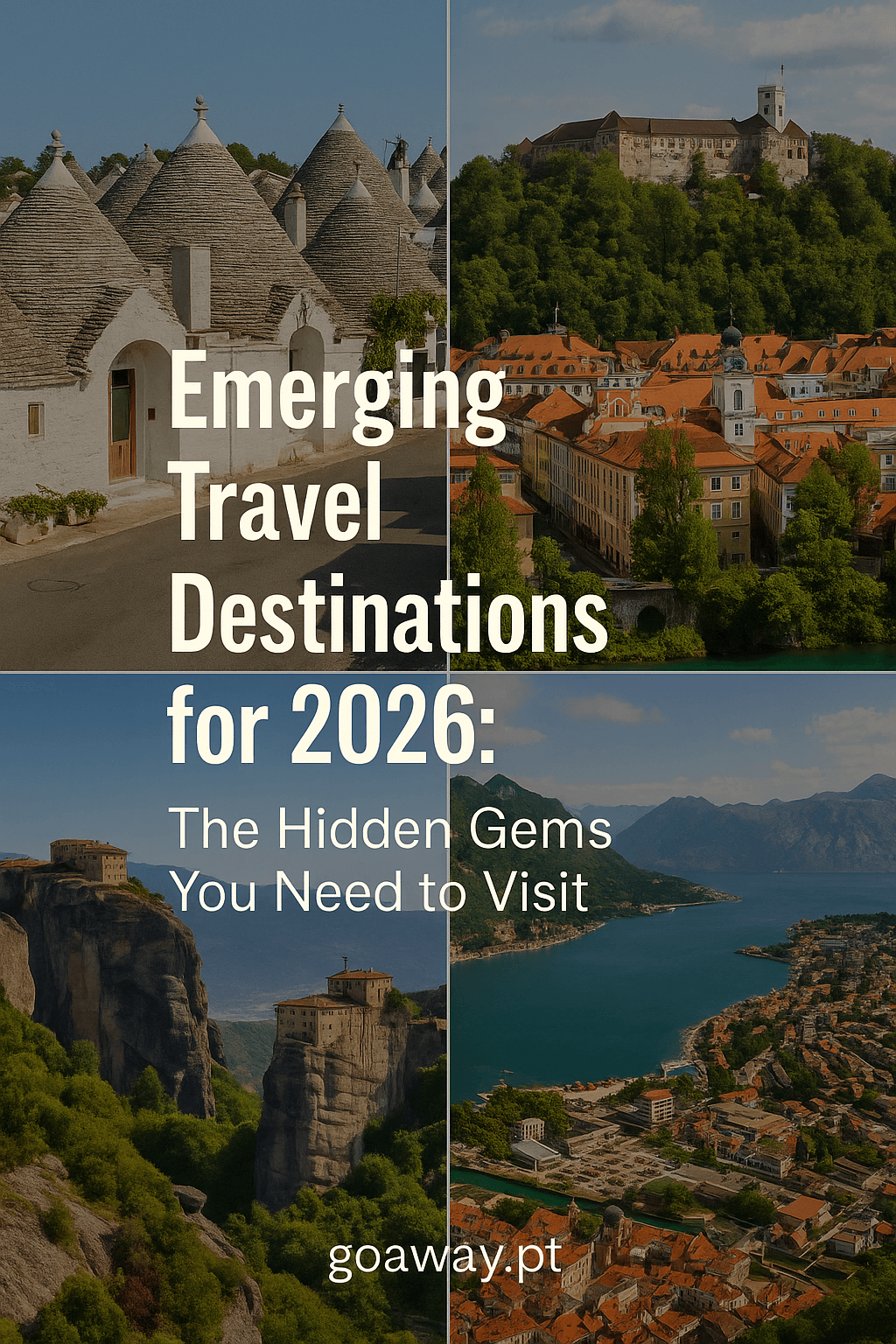
Emerging Travel Destinations for 2026: The Hidden Gems You Need to Visit
2026 Travel Outlook: This guide was compiled by GoAway.pt's editorial team drawing on current tourism data, emerging booking trends, and direct destination research. Destinations were selected for their combination of accessibility, cultural authenticity, and growing infrastructure for international visitors.
The world of travel is changing fast. As popular cities like Paris, Rome, and Barcelona continue to draw massive crowds, travellers are starting to look elsewhere — toward smaller towns, untouched coastlines, and places that blend authenticity with comfort.
If you're planning your 2026 adventures, here are 10 emerging destinations that promise unforgettable experiences, fewer tourists, and plenty of charm.
Quick Answer: The top emerging travel destinations for 2026 are Puglia (Italy), Ljubljana (Slovenia), Porto Santo Island (Portugal), Tallinn (Estonia), Kotor (Montenegro), Meteora (Greece), Braga (Portugal), Tbilisi (Georgia), Essaouira (Morocco), and the Faroe Islands — each offering authenticity, natural beauty, and a tourism infrastructure that's maturing without yet reaching saturation.
1. Puglia, Italy — Southern Italy's Slow-Travel Paradise
Once overshadowed by Tuscany and the Amalfi Coast, Puglia is finally stepping into the spotlight. Expect whitewashed villages, millennia-old olive groves, and turquoise beaches along both the Adriatic and Ionian coasts. Alberobello's iconic trulli houses — UNESCO-listed cone-roofed dwellings found nowhere else on earth — are just the beginning of this southern Italian fairytale.
🛏️ Where to stay: Boutique cave hotels (sassi) in Matera, or seaside masserie (farmhouse resorts) near Polignano a Mare.
🍝 Don't miss: Handmade orecchiette pasta in Bari Vecchia, and sunset views from the whitewashed hill town of Ostuni.
🏨 The Florence Hills Resort & SPA
2. Ljubljana, Slovenia — Europe's Green Capital
Europe's greenest capital is a dream for eco-conscious travellers. Compact, car-free in its centre, and unexpectedly charming, Ljubljana combines riverfront café culture, castle views, and easy access to Lake Bled, the Soča Valley, and the Adriatic coast — all within an hour's drive.
🚴 Why visit in 2026: Slovenia's sustainable tourism initiatives are setting global benchmarks, and Ljubljana has been recognised as a European Green Capital. Its cycling infrastructure, public transport, and eco-certified accommodation are among the best in Europe.
3. Porto Santo Island, Portugal — Madeira's Best-Kept Secret
This tiny island in the Madeiran archipelago remains one of Europe's best-kept travel secrets. Its 9-kilometre golden beach — with naturally therapeutic mineral-rich sand — offers year-round sunshine and crystal-clear Atlantic water, without the crowds of the Algarve. Porto Santo is a 2.5-hour ferry ride or 30-minute flight from Funchal, Madeira's capital.
🌊 Perfect for: Digital nomads, couples, or anyone seeking a genuine Atlantic island escape.
🏨 Porto Deluxe Apartments 🏨 OportoHouse
4. Tallinn, Estonia — Medieval Fairy Tale Meets Digital Future
Tallinn feels like stepping into a medieval fairy tale — cobblestone streets, Gothic spires, and a remarkably intact 14th-century city wall — but with fibre-optic Wi-Fi, a world-class food scene, and a technology culture that produced companies including Skype and TransferWise.
🏰 Explore: The UNESCO-listed Old Town, one of the best-preserved medieval city centres in Northern Europe, and the creative Telliskivi District for independent restaurants and design shops.
5. Kotor, Montenegro — The Adriatic's Rising Star
This small Adriatic gem is one of Europe's most dramatically situated cities: its medieval old town, enclosed by 4.5 km of city walls, sits at the foot of mountains that rise almost vertically from the bay. Montenegro is investing strategically in sustainable tourism infrastructure, maintaining Kotor's authenticity while improving accessibility for international visitors.
🧭 Why now: Montenegro gained EU candidate status in 2010 and is actively managing tourism growth to preserve the destination's character.
→ Kotor also features in our guide to Europe's hidden summer destinations
6. Meteora, Greece — Monasteries in the Sky
While Santorini dominates Greece's social media presence, Meteora quietly delivers one of the country's most extraordinary experiences: six active Orthodox monasteries perched atop giant sandstone pillars rising 400 metres from the Thessalian plain. A UNESCO dual World Heritage Site, Meteora is genuinely unlike anywhere else on earth.
📸 Tip: Visit in spring (April–May) or autumn (September–October) for thinner crowds and the best photography conditions. Sunrise views from the valley floor are among the most memorable in European travel.
7. Braga, Portugal — Portugal's Spiritual and Creative Heart
Portugal's oldest city — founded by the Romans as Bracara Augusta — is experiencing a significant modern revival. A large university population fuels a vibrant café and cultural scene, while a wave of boutique hotel openings has transformed the historic centre.
⛪ Don't miss: The Bom Jesus do Monte Sanctuary — a UNESCO World Heritage Site — and the nearby Peneda-Gerês National Park, Portugal's only national park, just 45 minutes away.
🏨 Origami Porto Residência & Hostel 🏨 HI Porto – Pousada de Juventude
8. Tbilisi, Georgia — The Caucasus's Culinary Capital
The capital of Georgia has emerged as one of the decade's most talked-about travel destinations. Colourful wooden balconies, ancient sulfur bathhouses, a thriving natural wine scene — Georgia is credited with inventing wine some 8,000 years ago — and a genuinely warm hospitality tradition combine in a city that feels entirely unlike anywhere else.
🍇 Emerging hotspot: Tbilisi offers a remarkable combination of affordability, authenticity, and world-class food culture. The surrounding countryside — including the wine region of Kakheti and the cave monastery complex of Vardzia — rewards those who venture beyond the capital.
9. Essaouira, Morocco — Atlantic Coast Culture and Calm
Where Marrakech can feel overwhelming, Essaouira is serene. This fortified Atlantic port city — a UNESCO World Heritage Site — combines Moroccan medina culture with a relaxed, wind-blown coastal atmosphere. The city is renowned for its gnawa music tradition, its vibrant artisan craft scene, and its exceptional surfing conditions.
🌅 Why 2026: New direct flight connections from several European cities and a growing number of restored riad boutique hotels are making Essaouira more accessible without yet diluting its character.
10. Faroe Islands — Europe's Last True Wilderness
Positioned between Iceland and Norway in the North Atlantic, the Faroe Islands offer the kind of dramatic, untamed landscape that has become increasingly difficult to find anywhere in Europe. Vertical sea-cliffs, hidden waterfalls, turf-roofed villages, and large Atlantic puffin colonies await travellers willing to make the journey.
🐦 Tip: Visit in summer (June–August) for long daylight hours and puffin-watching season. The Faroese government's Closed for Maintenance initiative invites visitors to help restore trails each spring — a world-leading example of participatory sustainable tourism.
Why These Destinations Matter for 2026
Emerging destinations aren't just about avoiding crowds — they're about discovering authenticity before it becomes a commodity. From eco-certified accommodation to untouched nature and living cultural traditions, these places offer what the modern traveller is genuinely seeking: meaningful experiences, local connection, and the sense of being somewhere truly new.
For more inspiration, explore our guides on underrated beach towns in Europe, hidden European destinations for summer, and unique European travel experiences you didn't know existed.
Ready to plan your 2026 trip? Find the best hotels at GoAway.pt.