Kalymnos Travel Guide 2026: Why Greece's Climbing Island Is Beating Santorini
While millions of travelers still fight for a sunset-view table in Oia or a rooftop bar in Mykonos Town, a rugged limestone island 300 kilometers southeast has quietly become one of Greece's most talked-about destinations for 2026. This Kalymnos travel guide covers everything you need to know about the Dodecanese island that airlines are suddenly racing to serve: Aegean Airlines, Lufthansa, British Airways, and EasyJet have all expanded flight frequencies to Kalymnos and its gateway island Kos in 2026, extending what used to be a short summer season into a near year-round window from February to November. The reason is climbing. Kalymnos is home to more than 4,000 bolted sport-climbing routes carved into golden limestone cliffs, and that reputation has pulled in a wave of travelers who want the Greek-island experience without the Santorini crowds or the Mykonos prices. Whether you climb or not, Kalymnos offers whitewashed harbor towns, a genuine sponge-diving history, quiet pebble beaches, and a day-trip islet you can reach by a five-minute boat ride. Here is how to plan a trip in 2026, drawing on current flight data, climbing-route information, and practical travel logistics.
Why Kalymnos Is Greece's Most Talked-About Island in 2026
Kalymnos sits in the Dodecanese island chain, between the better-known Kos and the tiny islet of Telendos, in the southeastern Aegean Sea. For decades it was known primarily within Greece for its sponge-diving fleet, but over the past fifteen years it has built a global reputation as one of the best sport-climbing destinations on the planet, alongside places like Siurana in Spain and Railay Beach in Thailand. What changed in 2026 is scale: airline capacity into the region has grown enough that travel publications are now describing Kalymnos as a legitimate alternative to Greece's most oversaturated islands, not just a niche climbing-community secret.
The appeal is straightforward. A meal in Pothia, the island's capital, typically costs a third less than an equivalent meal in Fira or Mykonos Town in high season, hotel availability is far less constrained even in August, and the pace of life has not been reshaped around cruise-ship schedules. For travelers who have already done the classic Cyclades island-hopping route and want something with more texture, Kalymnos is one of the more interesting answers in the eastern Mediterranean right now.
Getting to Kalymnos: Flights, Ferries, and the 2026 Airline Boom
There are two practical ways to reach Kalymnos. The first is a direct flight to Kalymnos's own small airport (Diagoras-adjacent island hop from Kos is common, but Kalymnos does have limited domestic service from Athens). The second, and more common route for international visitors, is flying into Kos International Airport, which now receives significantly expanded seasonal service from Aegean Airlines, Lufthansa, British Airways, and EasyJet, then taking a ferry or hydrofoil across the short strait to Kalymnos, a crossing of roughly one hour.
Booking Tips
Because Kos has become the main gateway, book your Kos flight and Kalymnos ferry as two separate legs rather than searching for a single itinerary, since most search engines will not combine them automatically. Ferries run several times daily in high season (April through October) and less frequently outside that window, so if you are traveling in the shoulder months, check the Greek ferry operator schedules before finalizing your Kos arrival time.
Rock Climbing in Kalymnos: 4,000+ Routes for Every Level
Climbing is the reason most first-time visitors now hear about Kalymnos, and the numbers explain why. The island has over 4,000 bolted routes across dozens of sectors, ranging from beginner-friendly slabs a few meters off the ground to multi-pitch overhangs that draw professional climbers from Europe and North America. The limestone here is famously featured with pockets, tufas, and stalactites, which makes for dramatic, photogenic climbing even for people who are only watching from the beach below.
Where to Climb
The most famous sector is the Grande Grotta, a vast cave whose ceiling is studded with tufa columns and steep overhanging routes for advanced climbers. Odyssey and Arhi are two of the more approachable sectors for climbers working through moderate grades, with a mix of sport routes in the 5a-6c range. Local climbing schools and guides in Masouri, the small village that has become the unofficial climbing hub, rent gear and run half-day and full-day courses for complete beginners.
When to Climb
The traditional climbing season ran October through April to avoid summer heat on south-facing rock, but the expanded flight schedule has pushed demand into a near year-round pattern, with shaded and north-facing sectors climbable even in the hottest months. If you are visiting purely for climbing, aim for March-May or September-November for the most comfortable conditions.

Beyond the Cliffs: Things to Do in Kalymnos
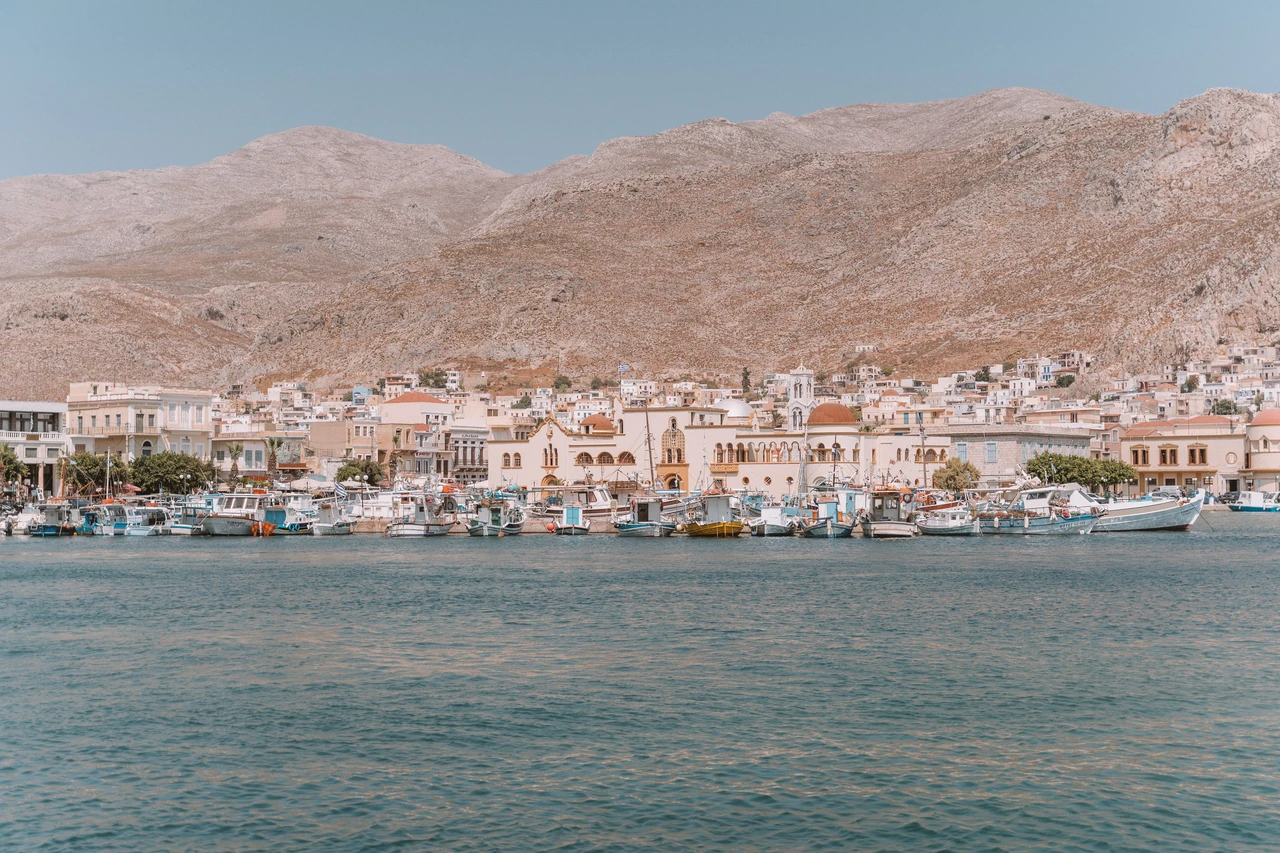
You do not need to touch a rope to enjoy Kalymnos. Pothia, the capital, is a genuine working port town with neoclassical buildings in ochre, pink, and blue climbing up the hillside from the harbor, plus a small archaeological museum and a nautical museum dedicated to the island's sponge-diving heritage. Vlychadia, on the southwest coast, has a dedicated sponge-diving museum next to a quiet pebble beach, and it is also the departure point for boats to the wreck of a World War II-era vessel that divers can explore.
Telendos Islet
A five-minute boat ride from Myrties brings you to Telendos, a car-free islet with a scattering of tavernas, a handful of small pebble beaches, and the ruins of a Byzantine settlement said to have been swallowed by an earthquake in the sixth century. It is one of the easiest, most rewarding half-day trips on the island.
Beaches
Melitsahas and Kantouni are the most accessible swimming spots near the climbing villages of Myrties and Masouri, while Emporios, on the island's quieter northern tip, has a narrow fjord-like inlet that is popular with boat-trip day visitors precisely because it still feels undiscovered.

Kalymnos vs. Santorini and Mykonos: Cost, Crowds, and Character
The comparison that keeps coming up in 2026 travel coverage is simple: what do you get on Kalymnos that you do not get in the Cyclades' two most famous islands? Primarily, breathing room. Santorini and Mykonos both regularly report cruise-ship arrivals in the thousands on peak summer days, which pushes restaurant and hotel prices up and crowds out the narrow streets that made those islands famous in the first place. Kalymnos has no cruise-ship dock of comparable scale, no caldera-view infinity pools commanding premium rates, and a resident population that still outnumbers tourists for most of the year outside of climbing festivals.
That trade-off will not suit everyone. If you specifically want the iconic blue-domed-church photo or Mykonos's beach-club scene, Kalymnos will not replicate that experience, and it should not try to. What it offers instead is a more grounded, lower-cost version of an Aegean island trip, with genuinely world-class outdoor recreation layered on top.
Best Time to Visit Kalymnos and Where to Stay
Late spring (April-May) and early autumn (September-October) offer the best balance of warm weather, lower prices, and manageable crowds, and they overlap with the best climbing conditions. July and August are hottest and busiest, though "busy" on Kalymnos still means quiet by Santorini standards. Winter (December-February) is mild but many tourist-facing businesses close, so it suits travelers who want solitude over amenities.
Masouri and Myrties, on the west coast, are the practical base for climbers, with the highest concentration of gear shops, climbing-focused guesthouses, and sunset-facing tavernas looking toward Telendos. Pothia is the better base if you want a more local, less climbing-oriented atmosphere with easier ferry connections. Both areas offer budget studios and small family-run hotels rather than large resort chains, which keeps average nightly rates well below Santorini's high-season prices.
Food and Culture in Kalymnos
Kalymnos's food culture is shaped by its maritime history. Look for local specialties such as octopus grilled over charcoal, seafood caught by the island's own boats, and dishes built around capers, which grow wild on the island's rocky hillsides and are used far more liberally here than in mainland Greek cooking. The island's sponge-diving heritage, once its main export industry before synthetic sponges reduced demand in the mid-20th century, is still visible in Pothia's harborside shops selling natural sea sponges, and it is worth learning the history at the Nautical Museum before buying one as a souvenir.
Frequently Asked Questions
Is Kalymnos good for non-climbers?
Yes. Climbing drives much of the island's recent attention, but Kalymnos also works as a quieter, lower-cost Greek island base for swimming, boat trips to Telendos, and exploring Pothia's harbor and museums.
How do I get from Kos to Kalymnos?
Fly into Kos International Airport, then take a ferry or hydrofoil across the strait to Kalymnos, a crossing of roughly one hour. Book the flight and ferry separately, since they are rarely bundled by search engines.
What is the best time of year to visit Kalymnos?
April-May and September-October offer the best mix of warm weather, thinner crowds, and prime climbing conditions. July-August is hottest and busiest, while winter is quiet but many businesses close.
How does Kalymnos compare in price to Santorini?
Kalymnos does not have Santorini's caldera-view premium pricing or cruise-ship-driven demand, so meals, guesthouses, and rental cars are generally noticeably cheaper, particularly in the climbing villages of Masouri and Myrties.
Do I need climbing experience to try the routes on Kalymnos?
No. Local climbing schools based in Masouri offer half-day and full-day introductory courses with rental gear for complete beginners, alongside routes suited to every experience level up to advanced multi-pitch climbing.
Planning Your Trip
Kalymnos rewards travelers who want an Aegean island trip with more room to breathe than Santorini or Mykonos currently offer, backed by a genuinely world-class outdoor activity in rock climbing. If you are building out a broader Mediterranean itinerary for 2026, our guide to the best time to visit Malta covers another underrated island with a similar shoulder-season advantage, and our roundup of Europe's cheapest cities for a weekend getaway is a useful companion for budget-conscious trip planning. For travelers drawn to Kalymnos's low-key, high-value character, our Sarajevo city-break guide and North Macedonia travel guide profile two more 2026 destinations built around the same idea: real experiences without the overtourism price tag. Start mapping your Kalymnos trip now, and you can beat the 2026 flight-booking rush that is already reshaping how this island is visited.