Sarajevo City Break 2026: Why It's Europe's Best Value Destination This Year
Every spring, travel researchers comb through hotel rates, transport costs, museum tickets and the price of a local beer to rank Europe's best-value city breaks — and for 2026, one capital keeps landing at the very top of that list: Sarajevo. Euronews' annual barometer put the Bosnian capital in first place, well ahead of usual budget favorites like Bucharest, Tirana and Belgrade, and Time Out separately named it the continent's best budget destination for the year. That's not a fluke. Sarajevo pairs Ottoman-era bazaars, Austro-Hungarian boulevards, a genuinely moving modern history and some of the best coffee culture in Europe — all at prices that feel like a throwback to a decade ago.
This guide draws on the same 2026 pricing data that put Sarajevo on the map, plus practical, on-the-ground detail on what to see, what to eat, when to go and how to plan a trip that will likely cost less than a long weekend in Lisbon or Prague. Whether you're weighing it against another rising Balkan destination or simply looking for a European city break that won't wreck your budget, here's everything you need to know before you book.
Why Sarajevo Is Europe's Best Value City Break in 2026
Euronews' 2026 city-break cost barometer — which tracks a fixed basket of items including a two-night hotel stay, meals, local transport, a museum visit and a drink — priced a weekend in Sarajevo at roughly €287, the lowest of any European capital surveyed and a fraction of what the same basket costs in Oslo, Copenhagen or Edinburgh, which topped the list as the continent's most expensive breaks. National Geographic readers separately voted Sarajevo into their "Best of the World" list, and several other 2026 roundups (Sofia, Tirana, Budapest and Bucharest among them) point to the same trend: south-eastern Europe is where budget-conscious travelers are getting the most for their money this year.
What makes Sarajevo stand out even within that group is that its affordability doesn't come at the cost of substance. You're not choosing between "cheap" and "interesting" — the city has UNESCO-recognized architecture, a market quarter that's been trading continuously for over 500 years, and a 20th-century history (the 1984 Winter Olympics, followed eight years later by the longest siege of a capital city in modern warfare) that gives it a depth few budget destinations can match. If you enjoyed the underrated-Balkans angle of our North Macedonia travel guide, Sarajevo is very much in that same spirit, just with an even lower price tag.
Getting to Know Sarajevo: Where East Meets West
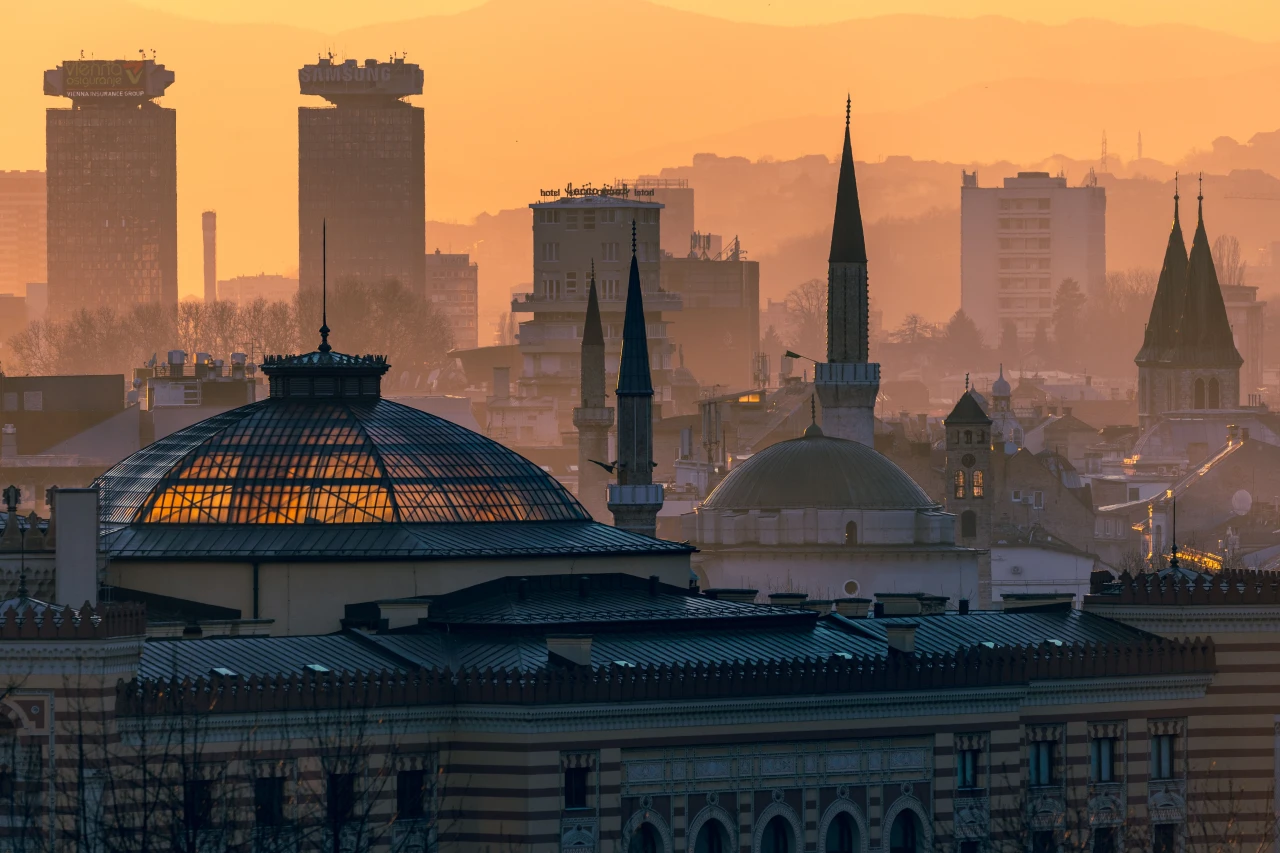
Sarajevo's nickname, "the Jerusalem of Europe," comes from a genuinely rare mix: mosques, an Orthodox cathedral, a Catholic cathedral and a synagogue all sit within a few streets of each other in the old town, a legacy of nearly 400 years of Ottoman rule followed by four decades under the Austro-Hungarian Empire. Walk west to east through the center and you'll feel the architecture shift in real time — from the domes and covered market alleys of the Ottoman quarter into wide, tree-lined boulevards and grand facades that could pass for Vienna or Budapest.
The Miljacka River splits the city and gives Sarajevo its long, narrow shape, hemmed in by the green hills — Trebević among them — that made it a natural amphitheater for the 1984 Winter Olympics, and which, tragically, gave besieging forces a clear line of sight into the city between 1992 and 1996. Understanding that geography helps almost everything else about a visit make sense, from the layout of the old town to the still-visible scars on some building facades.

Top Things to Do in Sarajevo
Baščaršija: The Old Bazaar
Almost every visit starts at Baščaršija, the Ottoman-era market quarter and the historic heart of the city. Its unofficial landmark is the Sebilj, a wooden fountain kiosk in the main square, and its most atmospheric corner is Kazandžiluk, the coppersmiths' street, where artisans have hammered trays, coffee pots (džezva) and jewelry for more than 500 years — you can still watch the work happen and buy directly from the makers. Give yourself at least half a day here to wander without a fixed plan, stopping for Bosnian coffee served the traditional way, in a copper pot with a lump of Turkish delight on the side.

Sarajevo's Modern History: The War Tunnel and the Siege
Sarajevo's 20th-century history is not a footnote — it's central to understanding the city, and most visitors find the sites connected to it among the most powerful they'll see anywhere in Europe. The Tunnel of Hope (Tunel Spasa), a preserved section of the hand-dug tunnel that was the city's only lifeline for supplies and people during the nearly four-year siege, is now a small, well-curated museum on the outskirts of town. In the center, the Museum of Sarajevo 1878–1918, near the Latin Bridge, covers the 1914 assassination of Archduke Franz Ferdinand that triggered the First World War — a reminder that this city has twice been at the hinge of European history within a single century. The rebuilt Vijećnica, Sarajevo's neo-Moorish city hall and former national library, is worth visiting for its restored interior alone.
Trebević Cable Car and the 1984 Olympic Legacy
For a different perspective, ride the Trebević cable car, rebuilt in 2018 after the original — a casualty of the war — sat unused for 26 years. The 15-minute ride up the mountain that hosted several 1984 Winter Olympics events delivers sweeping views back over the entire city, and at the top you can walk sections of the abandoned bobsled track, now covered in graffiti and slowly being reclaimed by forest. It's an unusual, slightly eerie, genuinely memorable way to close out the historical arc that runs through a Sarajevo visit — from Olympic host to besieged city to the calmer, fast-changing capital it is today.
Where to Eat: Sarajevo's Food Scene
Bosnian food is hearty, grill-and-pastry-driven, and — in keeping with the broader shift travel researchers have noted toward "hyper-local" food experiences over staged tourist menus — best eaten at small, family-run spots rather than restaurants aimed squarely at visitors. Start with ćevapi, grilled minced-meat sausages served in fresh somun flatbread with chopped onion and kajmak (a clotted-cream spread); the streets around Baščaršija have dozens of grill houses, most of them cheap and all of them proud of their own recipe. Burek — a spiral of flaky pastry filled with minced meat (or, in its cheese, potato or spinach variations, going by different names) — is the classic street-food breakfast, best bought from a bakery that's been making it for generations rather than a tourist-facing café.
Bosnian coffee deserves its own paragraph: unfiltered, slow-brewed in a džezva over an open flame or hot sand, and served with a ritual of its own. Sitting in Baščaršija over a coffee that costs a couple of euros, with no pressure to move on, is arguably the single best way to understand Sarajevo's pace of life. For something sweeter, look for tufahija (a whole poached apple stuffed with walnuts and cream) or baklava, both widely available around the old town.
What a Trip to Sarajevo Actually Costs
Based on the 2026 pricing data behind Sarajevo's best-value ranking, here's roughly what to expect. Accommodation is the biggest lever: a basic but well-located Airbnb or hostel bed runs around €40 a night, while a comfortable mid-range hotel room in or near Baščaršija averages €60–€90 in summer — a fraction of equivalent options in Western European capitals. Food is where the savings really add up: a full meal at a local restaurant typically costs €5–€8, a burek is €1–€2, and a pint of domestic beer runs about €2.30. Public transport (tram or bus) costs less than €1 per ride, and most of the historic center is walkable anyway. Put together, a comfortable long weekend — flights aside — is realistic on a budget that would barely cover two nights in cities like Amsterdam or Copenhagen. For a broader sense of how Sarajevo stacks up against other affordable options, our roundup of the cheapest European cities for a weekend getaway is a useful companion read.
Best Time to Visit and How Many Days You Need
Late spring (May–June) and early autumn (September–October) offer the best balance of mild weather, green hillsides and manageable crowds — broadly the same shoulder-season logic that makes destinations like Malta so appealing outside peak summer. July and August are warm and lively but busier and hotter, while winter brings genuinely cold temperatures and occasional snow, which suits travelers chasing a moodier, atmospheric version of the city (and cheaper flights and hotel rates).
Most travelers find two to three days enough to cover the essentials comfortably: a first day exploring Baščaršija and the old town at a relaxed pace, a second focused on the history-heavy sites and the Trebević cable car, and a third — if you have it — for a day trip. Sarajevo is also very safe by European standards, with locals and visitors alike reporting a strong sense of security during the day; the main practical precaution, as in any busy tourist area, is keeping an eye on your belongings around crowded spots like Baščaršija and on public transport.
Day Trips from Sarajevo
If you have a third or fourth day, two options stand out. Vrelo Bosne, the spring where the Bosna River emerges at the foot of Mount Igman, is a short tram-and-walk (or horse-carriage) trip from the city center and makes for an easy, scenic half-day among tree-lined avenues and clear turquoise water — it's also part of the same area used for several 1984 Olympic events. Further afield, Mostar, with its 16th-century Stari Most bridge over the Neretva River, is roughly a two-and-a-half-hour drive or bus ride and is easily done as a full-day trip, either independently or with one of the many tours that combine it with a stop in Blagaj, a small village built around a dervish monastery at the mouth of a river cave.
Frequently Asked Questions
Is Sarajevo safe to visit in 2026?
Yes. Sarajevo consistently rates as safe by European standards, with lower reported violent crime than many Western European capitals. The main risk for visitors is pickpocketing in crowded tourist areas, the same precaution you'd take in Rome or Barcelona.
How many days do I need in Sarajevo?
Two to three days covers the city itself comfortably. Add a third or fourth day if you want to fit in a day trip to Mostar or a more relaxed visit to Vrelo Bosne.
Do I need a visa to visit Bosnia and Herzegovina?
Travelers from around 120 countries, including the US, UK, EU and Canada, can enter visa-free for stays of up to 90 days within a 180-day period. Check your specific nationality's requirements before booking, as rules can change.
What currency does Sarajevo use, and is it card-friendly?
Bosnia and Herzegovina uses the Convertible Mark (BAM, also written KM). Cards are widely accepted in hotels, restaurants and larger shops, but it's worth carrying some cash for markets, small cafés and public transport.
What is Sarajevo best known for?
Historically, for hosting the 1984 Winter Olympics and for the 1914 assassination that triggered World War I; more recently, for the 1990s siege during the Bosnian War. Today, it's increasingly known simply as one of Europe's best-value, most walkable and most historically rich city breaks.
Plan Your Sarajevo City Break
Sarajevo's combination of low prices, genuine cultural depth and a compact, walkable center makes it one of the easiest cases for a European city break in 2026 — you'll spend less than you would almost anywhere else on the continent and come away with far more to talk about. If Sarajevo has you thinking about other rising, budget-friendly destinations, our guides to the best time to visit Malta and Georgia's Caucasus region cover two more places where your money goes further than the usual European hotspots. Start pricing flights, block out two or three days, and add Sarajevo to your 2026 travel list before the rest of Europe catches on.