Uzbekistan Travel Guide 2026: Silk Road Cities Now Visa-Free for Americans
For decades, Uzbekistan sat on most travelers' "someday" list — a country everyone associated with the Silk Road but few actually booked. That changed on January 1, 2026, when Uzbekistan made US citizens eligible for visa-free entry for stays of up to 30 days, a policy shift confirmed by Forbes and the country's own tourism authorities and layered on top of an already-generous list of more than 90 nationalities (including the UK, Canada, Australia, Japan, South Korea, and every EU member state) who can enter visa-free. We track emerging, low-hassle destinations for this publication every week, and Uzbekistan's combination of a genuinely new entry policy, a modernized high-speed rail network linking its four headline cities, and some of the best-preserved Islamic architecture on the planet makes it one of the strongest "go now, before everyone else catches on" picks we've covered this year. This guide walks through why 2026 is the moment, how to move between Samarkand, Bukhara, Khiva, and Tashkent, what each city actually offers, and everything you need on visas, money, food, and timing before you book.
Why Uzbekistan Is Having a Moment in 2026
Uzbekistan's tourism strategy has been years in the making, but 2026 is when several pieces landed at once. The headline change is the visa-free entry for US citizens that took effect January 1, 2026, reported by Forbes and corroborated by Uzbekistan's official travel guidance — a meaningful shift for a country that, within the last decade, required a full consular application for nearly every foreign visitor. The same expansion applies to travelers from the UK, Canada, and Australia, most of whom already enjoyed 30-day visa-free access under the country's broader liberalization that began in 2018 and has been extended and widened almost every year since.
Behind the visa news sits a genuine infrastructure push. The government has spent the past several years upgrading airports in Tashkent, Samarkand, and Bukhara, restoring historic quarters in all three Silk Road cities, and expanding the Afrosiyob and Sharq high-speed rail lines that now make it possible to see Tashkent, Samarkand, Bukhara, and Khiva on one trip without a single internal flight. None of this is a marketing press release dressed up as news — it is a real, dateable policy change paired with real transport infrastructure, which is exactly the kind of verifiable hook that tends to precede a genuine surge in visitor numbers rather than a manufactured one.
What makes Uzbekistan different from some of the other "underrated" countries we have covered is that it is not an undiscovered wilderness — it is a return to relevance for a place that was, centuries ago, one of the most important crossroads on Earth. Samarkand, Bukhara, and Khiva were essential stops on the Silk Road connecting China to the Mediterranean, and the scale and craftsmanship of what remains has few rivals anywhere in Central Asia or the Middle East.
Getting There and Getting Around: The High-Speed Rail Advantage
Most international flights land at Tashkent International Airport (TAS), with growing connections from Istanbul, Dubai, Seoul, Frankfurt, and other regional hubs; travelers from the US typically connect through Istanbul, Dubai, or Doha. Once you land, Uzbekistan's biggest practical advantage over its Central Asian neighbors is the Afrosiyob high-speed train, a Spanish-built Talgo train that covers the roughly 300 km between Tashkent and Samarkand in just over two hours, and continues on to Bukhara in about five and a half hours total from the capital.
Khiva sits further west and is not yet on the high-speed line, so most itineraries reach it either by an overnight train from Bukhara (around six hours) or a short domestic flight from Tashkent to Urgench, followed by a 30-minute taxi. Buying train tickets in advance through Uzbekistan Railways' official booking site is recommended in peak season (spring and autumn), since the Tashkent-Samarkand route in particular sells out on weekends. Inside each historic city center, everything worth seeing is walkable — Bukhara's old town and Khiva's walled city are both compact enough to explore entirely on foot, and Samarkand's main sights can be covered with a mix of walking and short taxi rides.
Samarkand: The Undisputed Heart of the Silk Road
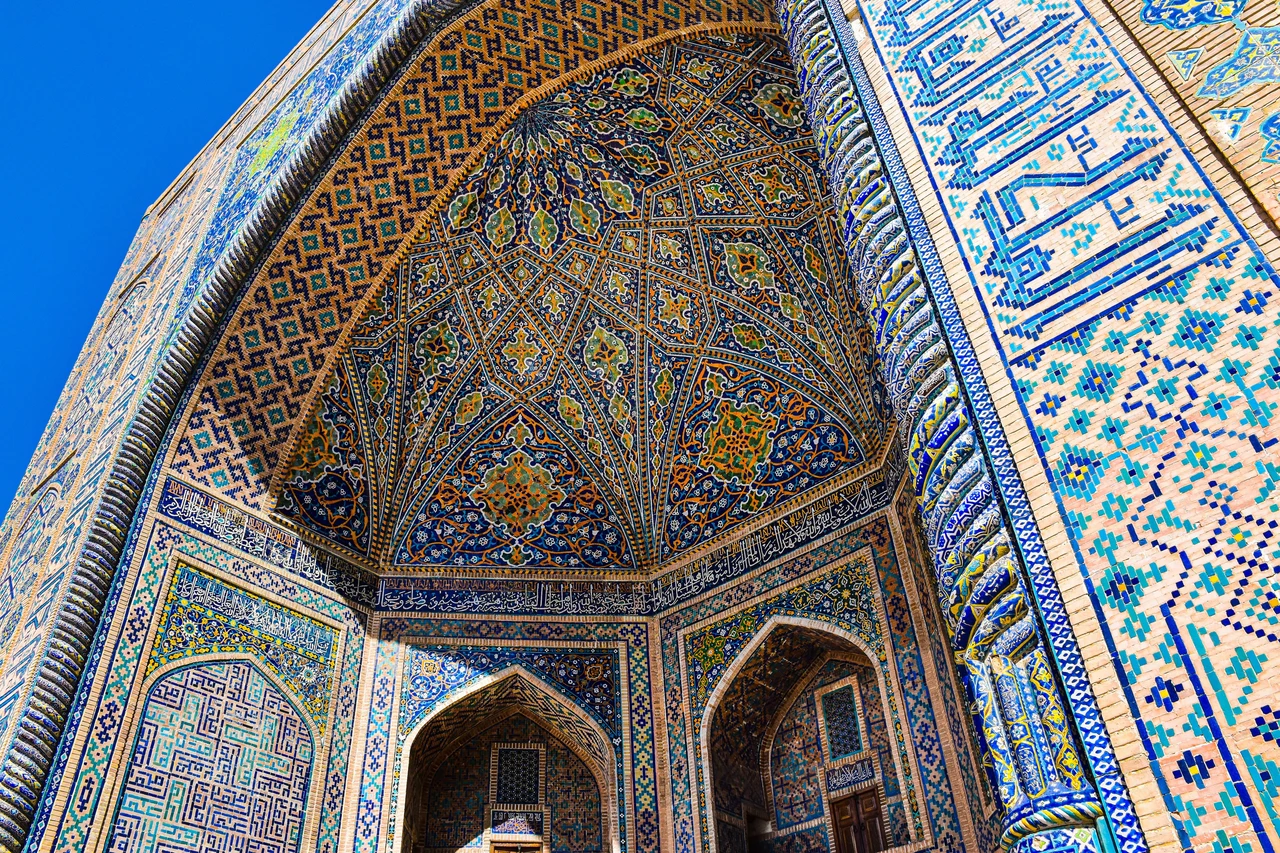
If you only have time for one city, make it Samarkand. Registan Square is the reason: three monumental madrasahs — the Ulugh Beg, Tilya-Kori, and Sher-Dor — face each other across a single plaza, each covered floor to minaret in turquoise and cobalt tilework that took generations of craftsmen to complete between the 15th and 17th centuries. Visiting at golden hour, when the low sun catches the mosaic patterns, is worth planning your schedule around.
Beyond the Registan, Samarkand rewards a full day or two of wandering. The Gur-e-Amir mausoleum holds the tomb of Timur (Tamerlane), the 14th-century conqueror whose empire funded much of the city's golden age, and its ribbed azure dome is one of the most photographed structures in Central Asia. Shah-i-Zinda, a narrow avenue of tiled mausoleums built up over several centuries, feels more intimate and less crowded than the Registan while showing off equally intricate tilework. The Siab Bazaar, just behind the Bibi-Khanym Mosque, is the place to try local non bread (a dense, ring-shaped flatbread baked in clay ovens) and dried fruit and nuts sold the same way they have been for centuries.

Bukhara's Living Old City and Khiva's Walled Museum Town
Where Samarkand impresses with scale, Bukhara charms with density — its entire old town is a UNESCO World Heritage Site, and unlike many historic centers, people still live, trade, and pray inside it. The Ark Fortress, a citadel occupied from the 5th century until 1920, anchors one end of the old city; the Poi Kalyan complex, with its 47-meter Kalyan Minaret (the tallest structure in Central Asia when it was completed in 1127 and reportedly the only building Genghis Khan spared when he sacked the city), anchors another. In between, the Lyabi-Hauz plaza, built around a 400-year-old pool shaded by mulberry trees, is the best place in the country for an evening meal with the old city lit up around you.
Khiva is smaller and more theatrical: the entire Itchan Kala inner city is walled and largely car-free, so once you pass through the gates you are inside an open-air museum of madrasahs, minarets, and mud-brick palaces, most within a 20-minute walk of each other. The squat, unfinished Kalta Minor Minaret — covered in turquoise tile and intended to be the tallest in the Islamic world before construction stopped in 1855 — is Khiva's most photographed landmark, especially at sunset when the light turns the tilework a deep gold-blue. Because Khiva sees far fewer visitors than Samarkand or Bukhara, it is also the best of the three cities for photography without crowds in your frame.
Tashkent: The Modern Gateway Worth a Day of Its Own
Most itineraries treat Tashkent as a layover between flights, and that undersells it. Uzbekistan's capital is a genuinely different experience from the Silk Road cities — a leafy, Soviet-planned metropolis with wide boulevards, one of the most architecturally striking metro systems in the world (each station individually themed, from cosmonaut motifs to cotton-flower chandeliers, and only cleared for photography since 2018), and Chorsu Bazaar, a domed market where the fresh produce and spice trade of Central Asia meets everyday city life. Independence Square and the Amir Timur Museum round out a comfortable one-day stop, and Tashkent's restaurant scene, more cosmopolitan than the smaller Silk Road cities, is a good place to try plov (Uzbekistan's national rice-and-lamb dish, cooked in enormous cast-iron kazans) prepared by a specialist rather than a general restaurant kitchen.

Practical Planning: Visas, Money, Food, and When to Go
US, UK, Canadian, Australian, and EU citizens can currently enter Uzbekistan visa-free for tourism stays of up to 30 days — always double-check your specific nationality's current status on Uzbekistan's official e-visa portal before booking, since visa policy has changed multiple times in recent years and can change again. The currency is the Uzbekistani som (UZS); card acceptance has improved sharply in Tashkent and Samarkand hotels and restaurants, but Bukhara, Khiva, and bazaars everywhere are still largely cash-based, so carry som for daily spending. Uzbekistan remains one of the most affordable countries in Central Asia — comfortable mid-range travel (private guides, good hotels, and a driver for day trips) typically runs noticeably cheaper than equivalent trips in Western Europe.
Beyond plov and non bread, don't skip shashlik (grilled skewered meat, often lamb), laghman (hand-pulled noodle soup with Central Asian roots shared with Xinjiang cuisine), and samsa (a baked, not fried, cousin of the samosa). The best time to visit is spring (April-May) or autumn (September-October), when daytime temperatures sit comfortably in the 20s°C and the desert heat of summer (which regularly exceeds 40°C in July and August in the Silk Road cities) has not yet arrived. A realistic first trip runs 7-10 days: two in Tashkent (arrival and departure), three in Samarkand, two in Bukhara, and two in Khiva, moving between cities by the Afrosiyob train wherever the route allows.
Frequently Asked Questions
Do US citizens need a visa for Uzbekistan in 2026?
No. As of January 1, 2026, US citizens can enter Uzbekistan visa-free for tourism or business stays of up to 30 days, a policy confirmed by Forbes and Uzbekistan's official tourism channels. Always verify current requirements on the government's e-visa portal before you fly, since policies can change.
How do you get between Samarkand, Bukhara, and Khiva?
The Afrosiyob high-speed train connects Tashkent, Samarkand, and Bukhara in a few hours each leg. Khiva is not yet on the high-speed line, so most travelers reach it via an overnight train from Bukhara or a short domestic flight from Tashkent to nearby Urgench.
Is Uzbekistan safe to visit?
Yes. The US State Department rates Uzbekistan Level 1, "Exercise Normal Precautions," its lowest advisory tier, as of January 2026. Standard travel common sense applies, but there are no elevated risk warnings for tourists.
How many days do you need in Uzbekistan?
A first trip covering Tashkent, Samarkand, Bukhara, and Khiva comfortably takes 7-10 days. If you only have 5 days, prioritize Samarkand and Bukhara, which are connected by a two-and-a-half-hour high-speed train ride and hold most of the country's headline sights.
What is the best time of year to visit Uzbekistan?
Spring (April-May) and autumn (September-October) offer the most comfortable weather, with mild days and cool evenings. Summer regularly exceeds 40°C in the Silk Road cities, and winter can bring freezing nights, especially in Samarkand and Bukhara.
Plan Your Silk Road Trip
Uzbekistan's mix of a brand-new, verifiable visa policy, genuinely world-class architecture, and an increasingly easy high-speed rail network is a combination that rarely lasts as "under the radar" for long. If Central Asia's blend of ancient trade routes and modern access has you planning a wider regional trip, our Kyrgyzstan travel guide covers the mountain and yurt-stay side of the region, while our Georgia travel guide explores the Caucasus end of the old Silk Road trade network. First-time solo travelers weighing whether a trip like this is manageable alone should also read our guide to safe solo travel in 2026, and if you're drawn to other destinations riding a similarly strong, verifiable 2026 hook, our Jaffna, Sri Lanka guide is cut from the same cloth. Book the Afrosiyob tickets early, bring cash for the bazaars, and go before the secret is fully out.