Wild Atlantic Way 2026: Ireland's West Coast Just Got a Direct Flight
For decades, a trip to Ireland's west coast has meant one thing for most international visitors: a long coach transfer from Dublin, a rushed look at the Cliffs of Moher, and a drive back before dark. That changed in April 2026, when Discover Airlines, the leisure carrier owned by Lufthansa, landed its first-ever flight to Ireland at Shannon Airport, connecting County Clare directly to Frankfurt for the first time. It is a small route on paper, twice a week, one aircraft, roughly two hours in the air, but it quietly solves the biggest logistical problem the Wild Atlantic Way has always had. This guide covers what the new route actually offers, which stretches of the west coast reward a visit most, what a realistic budget and itinerary look like, and the practical questions worth answering before you book. Every detail below is drawn from the airline's own announcements, tourism board data, and on-the-ground guides published in 2026, not guesswork.
A New Gateway: The Frankfurt-Shannon Route and Why It Matters
Discover Airlines' Frankfurt-Shannon service runs twice weekly, on Thursdays and Saturdays, from April 4 through October 26, 2026, using an Airbus A320. The inaugural flight departed Frankfurt on April 25, 2026, and the flight time is a little over two hours each way. It is the airline's first-ever Irish destination as part of a wider short-haul expansion for summer 2026 that added routes to Larnaca, Brindisi, Skiathos, and several other leisure destinations.
The significance is bigger than the route itself. Frankfurt is one of Europe's busiest hub airports, so travelers arriving from Asia, Africa, the Americas, or elsewhere in Europe can now connect onward to Shannon without routing through Dublin. That matters for the Wild Atlantic Way specifically, because Shannon Airport sits within an hour's drive of the Cliffs of Moher, the Burren, and Galway City, and within two hours of Connemara. A route that used to require flying into Dublin and driving three-plus hours west now starts you at the doorstep of the coast itself.
It's worth noting this is a seasonal, summer-only service (April to October), so it lines up neatly with Ireland's best weather window rather than running year-round.
County Clare: Cliffs of Moher and the Wild Burren
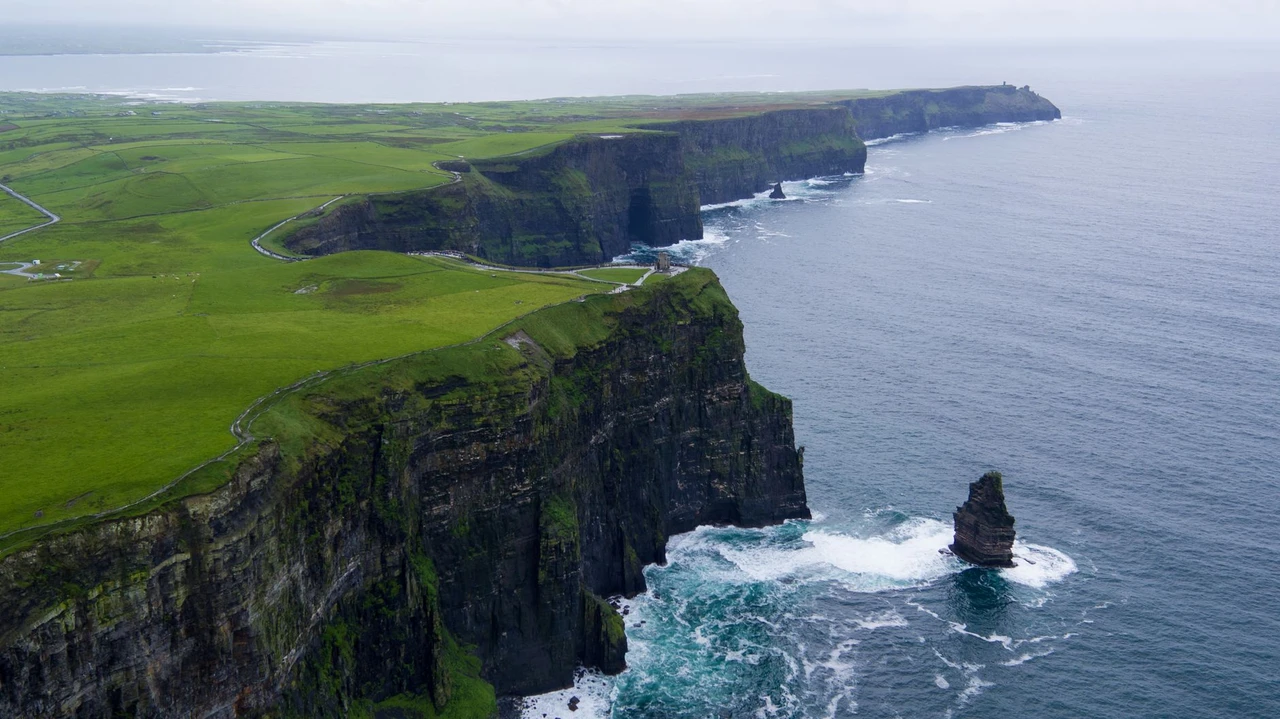
Clare is the logical first stop once you land, and it rewards more than the standard two-hour cliff-top visit most day-trippers get. The Cliffs of Moher themselves rise up to 214 meters above the Atlantic and are best experienced early morning or late afternoon, when the tour-bus crowds from Dublin have thinned out.
Beyond the cliffs
The Burren, a vast limestone karst landscape just north of the cliffs, looks almost lunar: bare grey pavement fractured into blocks, with rare alpine and Mediterranean plants growing in the cracks. The Burren Scenic Drive links its main sights, including ancient portal tombs and the atmospheric ruins of Corcomroe Abbey. On the coast, Lahinch is a proper surf town with a long sandy beach and a lively pub scene, while Fanore is quieter, backed by limestone hills and good for rock-pooling at low tide. Doolin, the traditional gateway to the Aran Islands ferries, is also one of the best places in the country to hear live traditional Irish music in a pub session.

Galway City and the Aran Islands
An hour north of Shannon, Galway City is the cultural heart of the west coast: a compact, walkable center built around the River Corrib, known for its live music, seafood, and a genuinely relaxed pace that contrasts with Dublin's bigger-city energy. The Latin Quarter's cobbled streets are lined with independent shops, buskers, and pubs that spill music onto the street most evenings.
From Galway or Doolin, ferries run out to the Aran Islands, three islands at the mouth of Galway Bay that feel like stepping back a century. Inishmore, the largest, is home to Dún Aonghasa, a UNESCO-listed prehistoric stone fort perched dramatically on a cliff edge with a sheer 100-meter drop on one side. Renting a bicycle to explore the island's stone-walled boreens is the most popular way to see it, and it can comfortably be done as a day trip from Galway or Doolin.
Connemara's Wild Fjord Country
West of Galway City, the landscape turns properly wild. Connemara is a region of bogland, mountains, and a jagged Atlantic coastline, best known for Killary Harbour, Ireland's only fjord, carved by glaciers between County Galway and County Mayo. Aasleagh Falls, a short walk from the village of Leenane at the fjord's head, is an easy, rewarding stop for anyone driving through.
Connemara National Park offers marked trails through the Twelve Bens mountain range, including a manageable climb up Diamond Hill with panoramic views back over the coast. On the coast itself, Dog's Bay and Gurteen Bay near Roundstone are two adjoining white-sand beaches with clear, turquoise water that would not look out of place in the Caribbean, minus the water temperature.

Practical Planning: Best Time to Visit, Getting Around, and Budget
May, June, and September are generally the sweet spot for the west coast: daylight hours are long, rainfall is comparatively lower than in winter, and the route's own summer-only schedule (April-October) aligns with this window. July and August are busiest and warmest, with average highs around 18-20°C, but book accommodation well ahead, especially in Galway and Doolin.
A rental car is close to essential here. Public transport connects the main towns, but the whole appeal of this coast, small coves, ruined abbeys, single-track roads through the Burren, depends on being able to stop wherever the view demands it. Roads are narrow and driving is on the left, which catches out some visitors on their first day.
Ireland uses the euro, and it is not a notably cheap destination: expect roughly €90-140 per night for a comfortable mid-range guesthouse or hotel outside Dublin, €15-25 for a casual pub meal, and €45-70 per day for a compact rental car in peak season. A week covering Clare, Galway, and Connemara at a moderate pace, with a couple of nights in each area, is a realistic and satisfying itinerary for a first visit.
Frequently Asked Questions
Do I need a visa to visit Ireland?
Ireland is in the EU but not part of the Schengen Area, so it has its own entry rules. Citizens of the US, Canada, the UK, Australia, New Zealand, and most EU/EEA countries can visit visa-free for up to 90 days for tourism. You should still carry proof of onward travel, accommodation, and sufficient funds, since visa-exempt status does not guarantee entry on its own.
How many days do I need for the Wild Atlantic Way from Shannon?
Five to seven days lets you cover County Clare, Galway City, the Aran Islands, and Connemara at an unrushed pace. Three days is workable if you focus on just Clare and Galway and skip the islands.
Is a car necessary, or can I get around by bus?
A car is strongly recommended. Bus Éireann connects the main towns, but many of the best stops, remote beaches, scenic drives, small villages, are impractical without your own transport.
When does the Frankfurt-Shannon flight operate?
Discover Airlines flies the route twice weekly, on Thursdays and Saturdays, from April 4 to October 26, 2026. It does not operate through the winter months.
Is the west coast of Ireland expensive compared to the rest of Europe?
It sits in the mid-to-upper range for Western Europe, similar to or slightly above cities like Lisbon or Porto, and below Iceland or Switzerland. Accommodation is the biggest cost, especially in peak summer.
Ready to Plan Your Trip
The Frankfurt-Shannon route won't turn County Clare into an overtouristed circuit overnight, and that's precisely the appeal right now: direct access to a coastline that rewards slow travel, without the Dublin bottleneck. Whether you build your trip around the Cliffs of Moher and the Burren, a ferry out to Inishmore, or Connemara's fjord and mountains, 2026 is a genuinely easier year to make it happen.
If you're drawn to landscapes that feel remote and dramatic, our guide to the best places to see the Northern Lights covers a similarly wild, nature-led trip further north, while Kalymnos in Greece is a good pick if you'd rather trade cliffs and rain for limestone and sunshine. For a slower-paced, less crowded Mediterranean alternative, see our piece on the best time to visit Malta. And if you're planning this trip solo, our 2026 solo travel guide has planning and safety advice that applies just as well to a self-drive route like this one.